One of the most common concerns after being diagnosed with a slipped or herniated disc is simple: do herniated discs heal on their own?
It is a question filled with hope, fear, and uncertainty at the same time. Most people want to avoid surgery, avoid long term medication, and return to normal life as quickly as possible. Back pain can feel overwhelming, especially when it affects sleep, work, and even simple daily movements like sitting, standing, walking, driving, or bending.
The truth is encouraging, but it also needs proper understanding.
Yes, many herniated discs do improve naturally over time. Some people recover fully without surgery or invasive treatment. However, not every case follows the same path, and recovery depends heavily on how the condition is managed, how early it is addressed, and how consistent the patient is with recovery habits.
Understanding how disc healing actually works is the key to making better decisions and avoiding unnecessary fear, overthinking, or delayed treatment.
So, Do Herniated Discs Heal on Their Own
The short answer is yes, in many cases they do.
Research shows that around 70 percent to 80 percent of herniated disc cases improve without surgery. Some people notice improvement within a few weeks, while others may take several months depending on severity, lifestyle, and response to treatment.
However, this does not mean the disc heals automatically without any support.
Natural healing only works effectively when the body is placed in the right conditions over time.
Conditions that support healing include:
- Gentle and consistent movement throughout the day
- Proper posture during sitting, standing, and sleeping
- Controlled activity without overloading the spine
- Physiotherapy guided rehabilitation exercises
- Good sleep quality and recovery routines
- Stress management and lifestyle control
- Avoidance of repeated injury or bad movement habits
Healing is not passive. The body has the ability to repair itself, but it needs the right environment, consistency, and time.
Many people assume rest alone will fix the problem. In reality, too much rest often leads to stiffness, weakness, and slower recovery.
What Actually Happens in a Herniated Disc
To understand recovery, you must first understand what is happening inside the spine.
A herniated disc occurs when the soft inner gel of a spinal disc pushes through its outer fibrous layer. This can irritate or compress nearby spinal nerves, leading to symptoms such as pain, numbness, tingling, or weakness.
Once this happens, the body immediately begins a natural healing response.
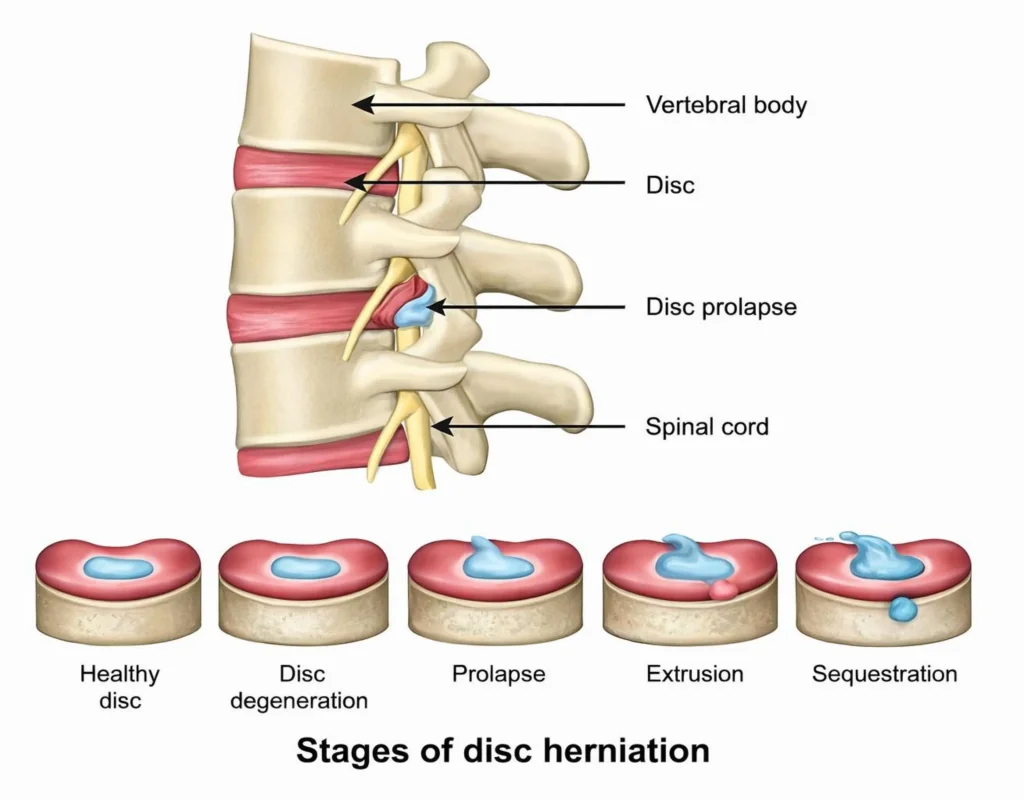
The healing response includes:
- Reducing inflammation around the affected nerve
- Activating immune cells to break down disc material
- Gradually absorbing the herniated disc fragments
- Reducing pressure on nerve roots over time
- Allowing nerve irritation to calm down naturally
- Restoring movement tolerance as swelling reduces
This biological process is known as disc reabsorption.
Medical research has shown through MRI scans that herniated disc material can shrink significantly over time in many patients. In some cases, large herniations reduce dramatically without surgery.
This is one of the reasons why symptoms often improve naturally.
However, healing speed depends on multiple internal and external factors.
The Healing Timeline Explained in Detail
Recovery does not happen overnight. It follows a gradual biological process.
Week 1 to 2 The acute painful phase
This is usually the most intense stage.
Common symptoms include:
- Sharp or burning pain
- Pain radiating down the leg or arm
- Muscle tightness and guarding
- Difficulty sitting, standing, or walking
- Disturbed sleep due to discomfort
Inflammation is at its highest during this phase. Although it feels like nothing is improving, the body has already started the healing process internally.
This stage is emotionally challenging because pain levels are at their peak.
Week 2 to 4 Early recovery phase
During this stage, inflammation begins to reduce.
Patients often notice:
- Slight reduction in pain intensity
- Improved movement tolerance
- Better sleep quality
- Reduced sharp pain episodes
- Increased confidence in daily movement
This stage is important because it confirms that the body is responding positively.
Week 4 to 8 Functional improvement phase
This is when recovery becomes more noticeable.
Typical improvements include:
- Pain becomes less frequent and less intense
- Ability to walk, sit, and stand improves
- Return to light daily activities
- Reduced reliance on pain medication
- Improved mobility and flexibility
At this stage, most people start feeling like they are recovering rather than just surviving pain.
Week 8 to 12 Strength and stability phase
This phase focuses more on rebuilding function.
Improvements include:
- Near normal daily activities
- Improved muscle control and stability
- Reduced nerve sensitivity
- Return to work in most cases
- Better confidence in movement
Some stiffness may still exist, especially after long activity or sitting.
3 to 6 months Full recovery and adaptation phase
Most patients reach a stable recovery phase here.
At this point:
- Symptoms are minimal or gone
- Daily activities are unrestricted
- Movement confidence is restored
- Core strength improves
- Risk of flare ups decreases
Although the disc structure may not return to its original shape, function is usually fully restored.
Why Some People Recover Faster Than Others
Recovery speed is not the same for everyone.
Severity of disc injury
Smaller bulges recover faster because there is less nerve compression. Larger herniations take longer and require structured rehabilitation.
Location of the disc
Lower back discs often affect walking, sitting, and bending more than upper spine issues.
Age and tissue health
Younger individuals generally heal faster due to better tissue regeneration. However, older adults can still recover well with proper care.
Activity level and movement habits
Complete rest slows recovery. Excessive movement can worsen symptoms. The ideal is controlled, guided activity.
Physiotherapy intervention
Early physiotherapy significantly improves outcomes by restoring movement safely and preventing poor movement habits.
Lifestyle factors
Smoking, poor sleep, stress, and prolonged sitting all slow healing.
Real Life Recovery Example Scenarios
To understand better how do herniated discs heal on their own, here are common recovery patterns:
A mild disc bulge patient may recover within 4 to 6 weeks with simple physiotherapy and walking.
A moderate herniation patient may take 8 to 12 weeks with structured rehabilitation and posture correction.
A severe disc herniation may take 3 to 6 months and require closer monitoring, sometimes including injection or surgical consideration.
Each case is different, but the majority improve without surgery when properly managed.
When Natural Healing Works Well
Natural recovery is most effective when:
Pain is moderate and gradually improving
No significant nerve damage is present
Movement is still possible without extreme limitation
The patient remains active in a controlled way
Physiotherapy or guidance is followed consistently
In these cases, most people recover fully without surgical intervention.
When You Should Be Careful
Not all cases should rely on natural healing alone.
You should seek professional assessment if:
- Pain is not improving after several weeks
- Symptoms are getting worse instead of better
- Numbness or weakness appears
- Daily activities become difficult
- Sleep is significantly affected
These may indicate that structured treatment is needed.
Red Flags That Require Immediate Attention
Some symptoms require urgent medical care:
- Loss of bladder or bowel control
- Severe or worsening leg weakness
- Numbness in both legs
- Sudden severe increase in pain
These may indicate serious nerve compression and should not be ignored.
What Helps the Body Heal Naturally
Recovery improves significantly when supported correctly.
- Gentle walking improves circulation and reduces stiffness
- Proper posture reduces pressure on spinal discs
- Physiotherapy strengthens muscles and improves control
- Good sleep supports tissue repair and recovery
- Stress management reduces inflammation and tension
- Avoiding heavy lifting prevents re irritation
The Role of Physiotherapy

When people ask do herniated discs heal on their own, the most accurate answer is that healing is significantly better with physiotherapy support.
Physiotherapy helps by:
- Teaching safe movement patterns
- Reducing nerve irritation
- Strengthening core muscles
- Improving posture and spinal mechanics
- Preventing re injury
- Speeding up functional recovery
Early intervention leads to better long term outcomes and fewer complications.
Is Surgery Necessary
Surgery is usually not the first option.
Most cases are managed conservatively for at least 6 to 8 weeks before considering surgical intervention.
Treatment usually includes:
- Physiotherapy
- Activity modification
- Pain management if required
- Regular monitoring
Surgery is only considered if:
- Symptoms are severe
- No improvement is seen
- Neurological function is worsening
Final Thoughts
So, do herniated discs heal on their own?
Yes, in most cases they do.
But healing is not passive. It requires:
- Proper movement
- Consistency
- Professional guidance when needed
- Time and patience
Ignoring symptoms or delaying treatment often leads to slower recovery and longer discomfort.
If you are unsure about your condition, early assessment can make a significant difference in your recovery journey.
For professional physiotherapy support and personalised care, you can visit MyPro PHYSIO, where treatment is tailored to your condition, symptoms, and recovery goals.
Disclaimer
This article is for educational purposes only. Recovery varies between individuals. Always consult a qualified healthcare professional for proper diagnosis and treatment advice.