Waking up with neck pain is frustrating in a very specific way. You go to bed feeling fine, but wake up stiff, sore, and sometimes unable to turn your head properly. For many people, this becomes a regular pattern rather than a one time issue.
The immediate assumption is usually “I slept wrong,” but the real issue is often more complex than just one bad night position. Sleep related neck discomfort, commonly referred to as neck pain sleeping, is usually the result of repeated strain, poor alignment, and habits that accumulate over time.
What makes this problem confusing is that it does not always hurt during the day. Instead, it shows up after rest, which makes it feel like the body is “breaking down” during sleep. In reality, sleep is when the neck finally stops compensating, and the hidden strain becomes noticeable.
This guide explains why it happens, what is actually going on inside your neck while you sleep, and how you can fix it long term instead of just temporarily.
Why Your Neck Hurts More After Sleeping
Sleep is meant to be a recovery period for the body, but for the neck, it can sometimes become a stress period if alignment is poor.
When you sleep, your muscles relax. This is good in normal conditions. However, if your neck has already been under strain during the day, sudden full relaxation in a poor position can expose tight joints and irritated tissues.
This is why people often wake up feeling worse than when they went to bed.
The most common reasons include:
- Pillow height that does not support the neck properly
- Sleeping positions that twist or tilt the cervical spine
- Mattress that does not support spinal alignment
- Pre existing muscle tightness from daily posture habits
Even small misalignments can add up over several hours of sleep.
What Is Happening Inside the Neck During Sleep
To understand neck pain sleeping, it helps to understand what your neck is doing overnight.
The cervical spine is designed to maintain a neutral curve. When this alignment is supported, muscles can fully relax and tissues recover.
However, when the neck is placed in an awkward position for hours, several things happen:
Muscles stay stretched or compressed for too long
Joint surfaces may experience uneven pressure
Blood flow to certain tissues becomes restricted
Nerve sensitivity may increase in irritated areas
The result is stiffness when you wake up because the tissues need time to “re-adjust” after being held in a strained position.
This is not damage in most cases. It is more like temporary overload that becomes noticeable after rest.
Common Sleep Positions That Trigger Neck Pain
Not all sleeping positions are equal when it comes to neck health.
Some positions naturally support alignment better, while others increase strain without you realizing it.
Typical problematic patterns include:
- Sleeping on your stomach with the head turned to one side
- Using too many pillows that push the head forward
- Very flat pillow that does not support the neck curve
- Side sleeping without proper shoulder and neck alignment
Among these, stomach sleeping is often the most stressful because it forces the neck into rotation for long periods.
Even if it feels comfortable initially, the cumulative strain becomes noticeable over time.
The Role of Your Pillow and Mattress
People often focus only on sleeping posture, but support from your pillow and mattress is equally important.
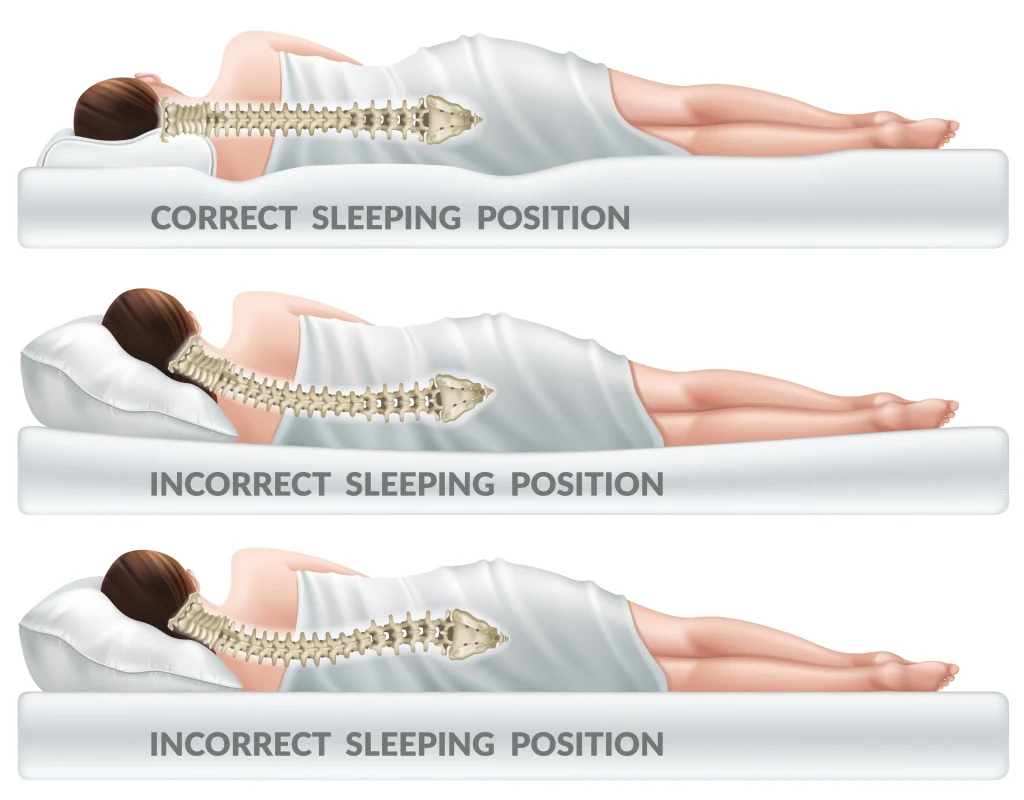
Your pillow is not just for comfort. It is responsible for maintaining the natural curve of your cervical spine.
If the pillow is too high, the neck bends forward. If it is too low, the neck drops backward. Both positions create strain.
A supportive setup usually allows:
- Neck to stay aligned with the spine
- Shoulders to rest comfortably without elevation
- Head to remain neutral without tilting
Your mattress also plays a role by supporting the entire body evenly. If it is too soft or too firm, it can indirectly affect neck alignment.
Why Neck Pain Appears Only in the Morning
A common question people ask is why pain only appears after sleep.
During the day, movement keeps the neck active and blood circulation consistent. Even if posture is not ideal, frequent movement prevents stiffness from building up.
At night, however, the body remains in one position for several hours. If that position is not supportive, strain accumulates silently.
When you wake up and start moving again, the tissues suddenly shift from stillness to activity. This is when stiffness becomes noticeable.
That is why neck pain sleeping issues often feel worse in the morning and gradually improve during the day.

How Poor Daytime Habits Affect Night Pain
Sleep related neck pain is not always caused by sleep itself. Often, it is influenced by what happens during the day.
If the neck is already tight or overworked during waking hours, it becomes more sensitive at night.
Common contributing habits include:
- Long hours looking down at phones
- Sitting with forward head posture at work
- Lack of movement breaks during the day
- High stress leading to muscle tension
These factors create baseline tightness that shows up more clearly during sleep.
Simple Adjustments That Can Make a Big Difference
Improving sleep related neck pain does not always require complicated solutions. Small adjustments can significantly reduce strain.
Helpful changes include:
- Choosing a pillow that supports natural neck curve
- Sleeping on your back or side instead of stomach
- Keeping the neck in a neutral position
- Avoiding multiple stacked pillows
- Ensuring mattress provides even support
These changes help maintain alignment so muscles can actually rest during sleep.
When Neck Pain Becomes a Repeated Problem
If neck pain after sleeping happens occasionally, it is usually related to temporary strain.
However, when it becomes frequent, it may indicate a deeper issue such as muscle imbalance or postural dysfunction.
At this stage, the body is no longer recovering properly during sleep. Instead, it is carrying accumulated tension from day to day.
Signs it may be more than just sleeping position include:
- Regular morning stiffness
- Pain that lasts beyond a few hours after waking
- Shoulder tightness along with neck discomfort
- Reduced neck mobility during daily activities
When these patterns appear, addressing only sleep position is usually not enough.
How Physiotherapy Helps Long Term Relief
This is where professional assessment becomes important.
Physiotherapy does not only focus on where the pain appears, but why it is happening in the first place.
In cases of neck pain sleeping, treatment often focuses on:
- Releasing tight muscles in neck and shoulders
- Improving joint mobility
- Correcting posture imbalances
- Strengthening weak stabilising muscles
At MyPro PHYSIO, this approach is combined with lifestyle correction so that both daytime habits and sleep posture are addressed together.
This is important because fixing sleep alone without correcting daily strain often leads to recurring issues.
When You Should Get Help
Not all neck pain requires treatment, but recurring or worsening symptoms should not be ignored.
It may be time to seek professional help if:
- Pain happens frequently after sleep
- Stiffness affects daily movement
- You feel recurring tightness despite changing pillows
- Symptoms are getting progressively worse over time
Early intervention usually leads to faster and more stable recovery.
Final Thoughts on Neck Pain Sleeping
Waking up with neck pain is not just bad luck or a single wrong sleeping position. It is usually the result of repeated strain, posture habits, and lack of proper support during rest.
Understanding neck pain sleeping means looking at the full picture, not just what happens at night but also what builds up during the day.
The good news is that most cases improve significantly once the root cause is addressed. With better sleep alignment, improved daily posture, and proper treatment when needed, recovery is very achievable.
CTA
If you are frequently waking up with neck stiffness or discomfort, it is a sign that your neck is not recovering properly during sleep.
Visit MyPro PHYSIO for a detailed assessment and personalised treatment plan designed to address neck pain sleeping issues from the root cause, not just the symptoms.